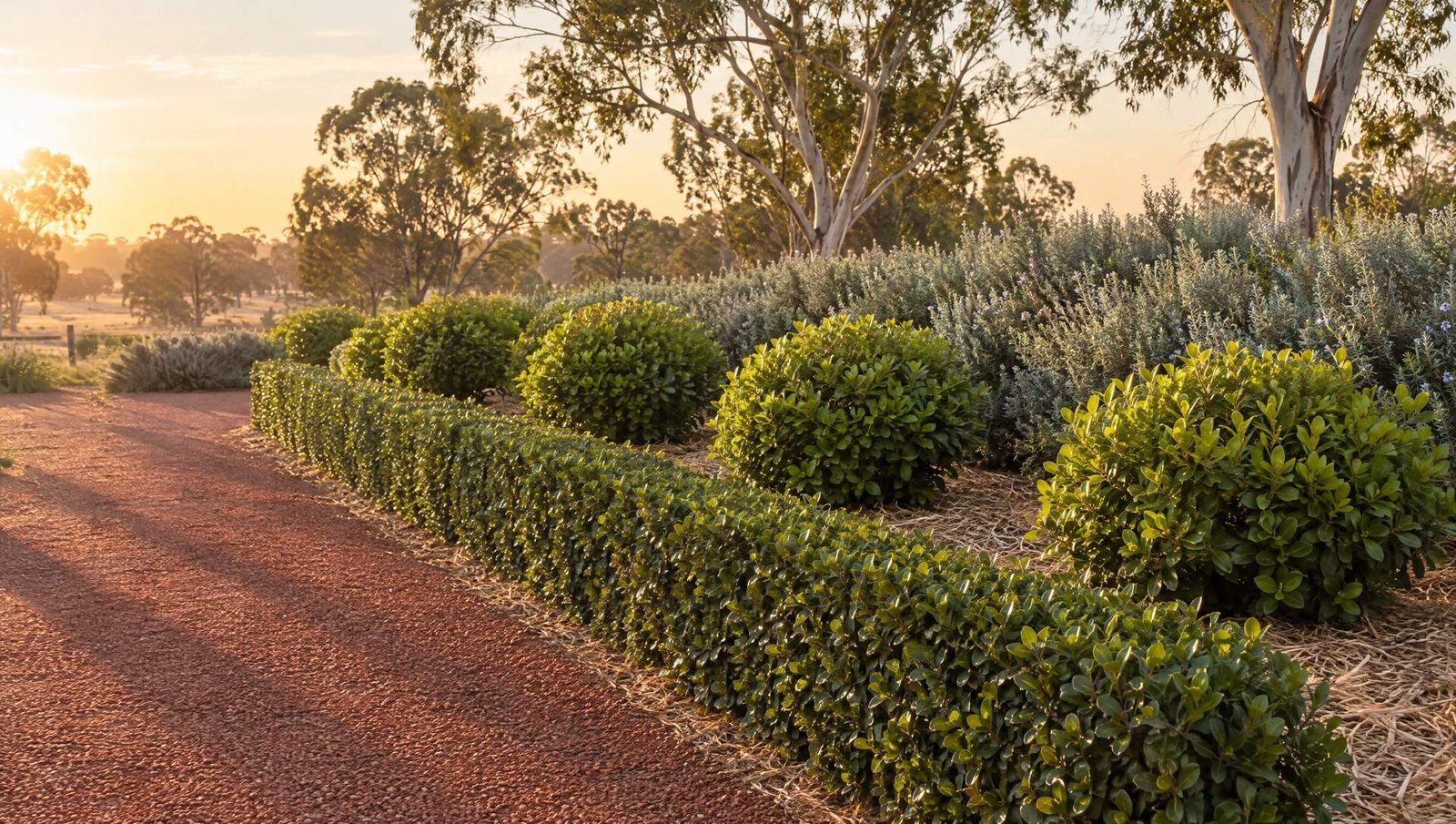
Euonymus1 to 1.5 m
Euonymus 'Green Rocket'
Euonymus japonicus
The hedge plant we stock most. Glossy dark green leaves on a narrow, upright habit, so it makes a tight formal hedge without taking over the path. Takes a hard clip and copes with Swan Hill heat once its roots are down.
Heat tolerantFrost hardyNursery favourite
Euonymus30 to 60 cm
Euonymus 'Tom Thumb'
Euonymus japonicus microphyllus
A tiny-leafed dwarf that does the job of English box in a hot garden. Use it for knee-high edging along paths and garden beds, or clipped balls in pots.
Heat tolerantFrost hardyNursery favourite
PittosporumAbout 1 m
Pittosporum 'Golf Ball'
Pittosporum tenuifolium
Forms a neat lime-green ball on its own with very little clipping. We reorder it more than almost anything else in the nursery. Plant in a row for a soft, rounded low hedge or use singly to mark an entry.
Frost hardyNursery favourite
Westringia0.6 to 1 m
Westringia 'Goldie Box'
Westringia hybrid
A compact native box alternative that holds its shape with an occasional trim. Tough on wind, heat and dry soil.
Australian nativeDrought tolerantFrost hardy
Westringia0.6 to 1 m
Westringia 'Grey Box'
Westringia fruticosa 'WES04'
Fine silver-grey leaves on a dense, low shrub. A good choice for a grey-toned garden or a low hedge in full sun.
Australian nativeDrought tolerantSalt tolerant
Westringia1 to 1.5 m
Westringia 'Smokey'
Westringia fruticosa
Grey-green leaves edged in cream, and small white flowers on and off through the year. Hedges well and handles poor soil.
Australian nativeDrought tolerantFrost hardyNursery favourite
Westringia1 to 1.5 m
Westringia 'Naringa'
Westringia hybrid 'WES01'
Grey-green leaves and mauve flowers. Use it for an informal native hedge that the bees will visit.
Australian nativeDrought tolerantFrost hardy
Nandina40 to 60 cm
Nandina 'Nana'
Nandina domestica
Dwarf sacred bamboo that colours up red and orange in the cold months. Low, tidy and happy in sun or part shade, so it suits borders and mass planting.
Frost hardyHeat tolerantNursery favourite
Nandina60 to 90 cm
Nandina 'Moon Bay'
Nandina domestica
Lime-green leaves in summer turning red in winter. A little taller than 'Nana' and just as easy.
Frost hardyHeat tolerant
Nandina60 to 90 cm
Nandina 'Obsession'
Nandina domestica 'SEIKA'
Bright red new growth through the warmer months on a compact plant. Colour without flowers.
Frost hardyHeat tolerant
RhaphiolepisAbout 1 m
Rhaphiolepis 'Snow Maiden'
Rhaphiolepis indica
Dense, leathery leaves and clusters of white flowers in spring. Very tough in heat and dry spells, and a regular on our reorder list.
Drought tolerantHeat tolerantFrost hardyNursery favourite
Rhaphiolepis1 to 1.5 m
Rhaphiolepis 'Oriental Pearl'
Rhaphiolepis indica
White spring flowers on a compact, rounded shrub. A low-care alternative to box for a clipped or natural hedge.
Drought tolerantHeat tolerant
Germander1 to 1.5 m
Silver germander
Teucrium fruticans
Silver leaves and pale blue flowers. Very drought hardy and quick to fill a gap, it suits a clipped grey hedge in the hottest, driest spot.
Drought tolerantHeat tolerantFrost hardy
Michelia2 to 3 m
Port wine magnolia
Michelia figo
Glossy leaves and small cream flowers with a sweet, fruity scent in spring. Plant where you'll walk past it. It does best with regular water and some shelter from the hottest afternoon sun.
Frost hardyNursery favourite
Choisya1.5 to 2 m
Mexican orange blossom
Choisya ternata
Glossy aromatic leaves and scented white flowers in spring. Give it morning sun and afternoon shade in Swan Hill.
Frost hardyNursery favourite
Viburnum2 to 3 m
Viburnum 'Dense Fence'
Viburnum odoratissimum 'VOC1'
Bred for screening: dense from the ground up with large glossy leaves. Good for blocking a neighbour's window or a side fence.
Frost hardyHeat tolerant
Conifer3 to 5 m
Juniper 'Spartan'
Juniperus chinensis
A narrow, upright conifer for tall, slim screens where there's no room for width. One of the most drought tolerant screening plants we sell.
Drought tolerantHeat tolerantFrost hardy
Conifer3 to 5 m
Cypress 'Lemon Scent'
Cupressus macrocarpa
Bright lime-gold foliage that smells of lemon when brushed. A cheerful tall screen or a feature in a large pot.
Frost hardyHeat tolerant
Lilly pilly1.5 to 2 m
Lilly pilly 'Backyard Bliss'
Syzygium australe 'PC1'
A compact native lilly pilly with red-tinged new growth. Protect young plants from hard frost for their first winter.
Australian nativeFrost tender when young
Gardenia0.5 to 1.5 m
Gardenias
Gardenia augusta
We bring in several varieties, including 'Florida', 'Professor Pucci' and 'Four Seasons'. Heavily scented white flowers through the warmer months. Gardenias prefer slightly acid soil, so in Swan Hill grow them in pots or well-improved beds.
Needs shelterNursery favourite