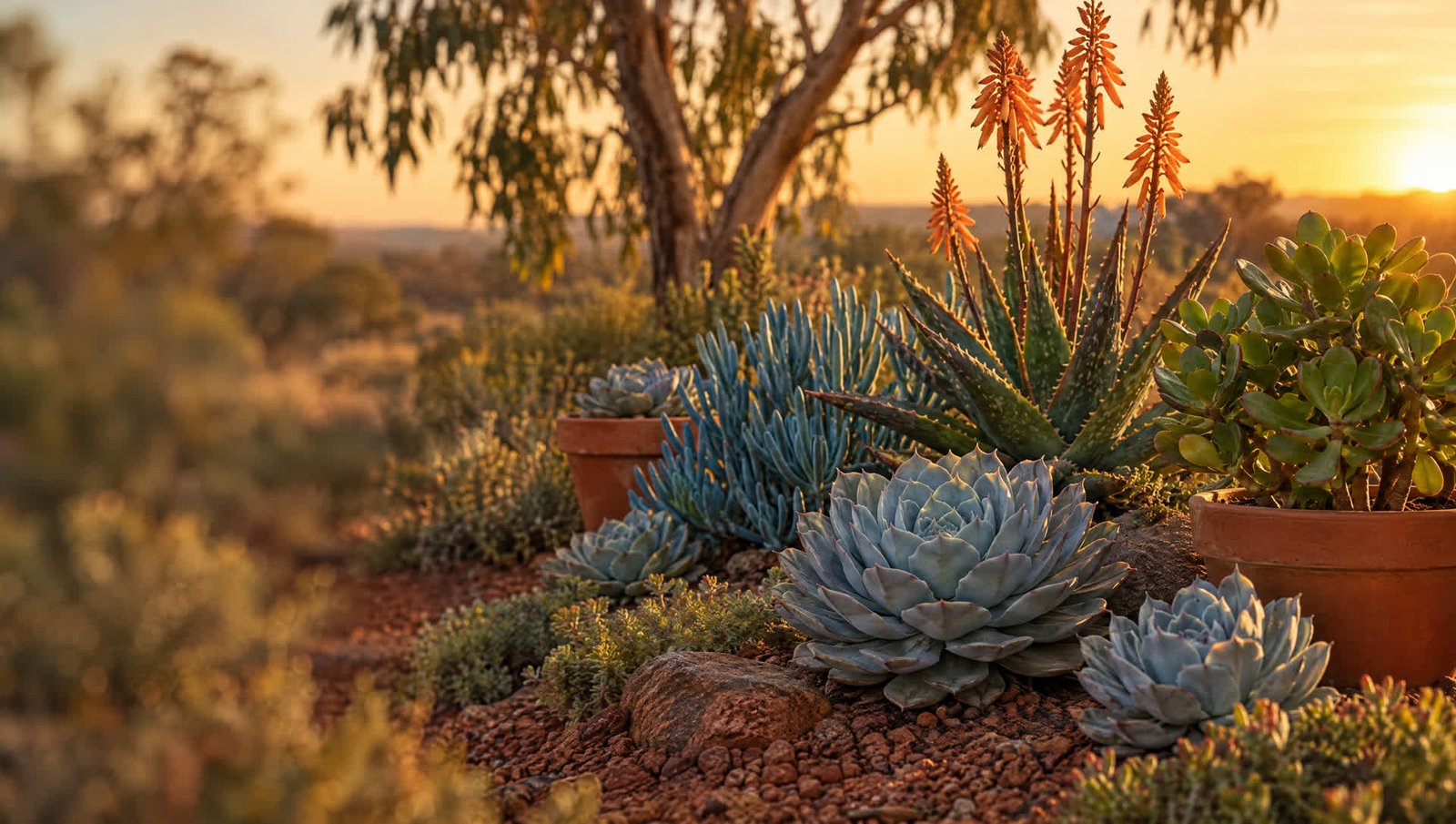
Blue echeverias, blue chalksticks and a flowering aloe in red gravel and terracotta pots at sunset
Succulents · Swan Hill and the Mallee

Succulents: nature's own water tanks.

Succulents were built for Swan Hill weather. Blazing summers, low rainfall and alkaline soil don't faze them: they store water in their leaves. The trick is choosing ones that also handle our frosts, and we'll help you get that right.

Full sunFrost hardy picksPots and garden beds
Succulents for Swan Hill

Easy care, once you know the one rule

Succulents are sold as easy care plants, and they are, once you understand the one thing they really care about: drainage. More succulents die from overwatering and soggy soil than from anything else, Swan Hill's 40°C days included.

Our hot, dry summers suit succulents beautifully. The challenge is frost. Not every succulent copes when the temperature drops, and in the Mallee frosts usually run from mid-May to early September. We choose the varieties we stock with both extremes in mind, and they fall into two groups.

IN THE GROUND ALL YEAR

Frost hardy succulents

Plant them out and leave them out, frost and all.

  • Hens and chicks (sempervivum)
  • Stonecrop (sedum)
  • Century plant (Agave americana)
  • 'Blue Elf' aloe
  • Ice plant (delosperma)
POTS YOU CAN MOVE

Frost tender succulents

Grow them in pots and move them under cover by mid-May. Aloe vera and jade can also go in the ground against a warm, sheltered north-facing wall.

  • Echeveria
  • Jade plant
  • Kalanchoe
  • Zebra plant (haworthia)
  • Elephant bush
  • Aloe vera (light frost only)
WHAT YOU'LL PAY AT RHIMAHDEN

Succulent prices

Small pots and tube stock from $5. 15 cm nursery pots from $12. Advanced specimens from $25. Established agave and aloe from $35. Stock changes with the seasons, so call 0409 389 586 or pop in to see what's available.

The range

Succulents for full sun, pots and frost

Twelve succulents chosen for Swan Hill, with where each one does best and how much frost it can take.

Stock changes with the seasons, and new varieties come in regularly.Call 0409 389 586 to check

GardenBest for beginners

Hens and chicks

Sempervivum species

If you designed a succulent for Swan Hill, it would look a lot like this. It takes far harder frosts than we get, handles the heat, needs very little water and doesn't mind poor soil. Rosettes come in green, red, purple, bronze and silver, and the plant spreads itself with clusters of "chicks" around the central "hen". One of the easiest plants there is to keep alive.

Best for: rockeries, path edges, shallow pots and steep slopes.

Extremely frost hardyFull sunVery drought tolerantSelf-spreading

Garden and potSwan Hill classic

Aloe vera

Aloe barbadensis

The one most people know, grown around Australian homes for generations. It takes a Swan Hill summer in its stride, needs almost no water once settled, and makes pups to share with the neighbours. The gel inside the leaves is handy first aid for sunburn and minor burns. It takes light frost only, so plant it against a north or west-facing wall or in a pot you can move.

Best for: garden beds, large pots and north-facing walls.

Light frost onlyLoves full sunVery drought tolerant

GardenStatement plant

Century plant

Agave americana

Few plants make a statement like a full-grown agave: a big, architectural rosette of blue-grey, spined leaves. It evolved in the dry country of Mexico, so it's right at home in the Mallee. Frost tolerant once established and long-lived, it will anchor a garden for decades. Variegated forms with cream-edged leaves are especially striking. Give it room, good drainage and full sun.

Best for: feature spots, gravel gardens and large statement pots.

Frost hardy once establishedFull sun essentialExtremely drought tolerant

Garden and pot

Stonecrop

Sedum, various

One of the most varied succulent families: some are low, spreading groundcovers, others upright clumps. They share great drought tolerance, brilliant autumn colour and the toughness to handle frost that would finish softer succulents. 'Dragon's Blood' (deep crimson, spreading) and 'Autumn Joy' (dusty pink flower heads, upright) both do very well in Swan Hill. Most like full sun and sharp drainage, and they thrive on neglect.

Best for: rockeries, borders, pots and groundcover.

Very frost hardyDrought tolerantAutumn colourBees love it

Pots, protected in winterMost popular

Echeveria

Echeveria, many cultivars

The rosettes most people picture when they think of succulents, in seafoam green, lavender-grey, deep burgundy or rose-tipped cream. Sun brings out their richest colours. They're happiest in pots on a verandah or in a spot with morning sun and some afternoon shade. Frost is their weakness: they take a light frost but need cover through winter. Move pots under the eaves by mid-May and they'll reward you in spring.

Best for: pots, verandahs, and under cover in winter.

Frost tenderVery drought tolerantVivid colours

GardenGroundcover

Ice plant

Delosperma species

Don't let the name fool you: ice plants do as well in heat as in frost. This low, spreading South African succulent covers itself in bright daisy flowers in magenta, yellow, orange and purple through spring and summer, and several species are very cold hardy. It spreads quickly into a dense mat that smothers weeds. Great on banks, along driveways or spilling over walls. Give it full sun and good drainage.

Best for: banks, walls, rockeries and driveways.

Cold hardy speciesFull sunProlific flowersFast spreading

Garden and potLong lived

Jade plant

Crassula ovata

One of the most forgiving plants you can grow. In a sheltered spot a jade can live for decades and grow into a small shrub. Its glossy, oval leaves hold plenty of water, so it rides out long dry spells. In Swan Hill, grow it in a pot and move it under the eaves for winter, or plant it in a warm, sheltered north-facing spot. Clusters of pale pink star flowers in winter are a lovely surprise. Said to bring good luck. We can't promise that, but it does look great.

Best for: pots, sheltered north walls and bright spots indoors.

Frost tenderVery drought tolerantIndoors and out

Pots and indoorsShade tolerant

Zebra plant

Haworthia species

The succulent for spots in and around the house that don't get full sun. Unlike most succulents, haworthia prefers bright, indirect light to harsh sun, so it suits windowsills, shaded verandahs and bathrooms with natural light. Striking white stripes across dark green leaves, and it stays small and compact. It's completely frost tender, so keep it in a pot and bring it inside for the Swan Hill winter.

Best for: windowsills, shaded verandahs, offices and gifts.

Keep frost freeDrought tolerantIndoors

Garden and potHedging

Elephant bush

Portulacaria afra

A cheerful, fast-growing South African succulent that looks like a small-leaved jade and grows just as easily. Round, fleshy leaves on reddish stems, and it takes pruning well, so people use it for hedging, bonsai or shaping into a small feature shrub. Variegated forms with cream-edged leaves are lovely. Handles heat and drought very well once established. Protect it from hard frost: a warm, sheltered spot or a large pot you can move under cover.

Best for: large pots, sheltered beds and informal hedging.

Shelter from hard frostLoves heatDrought tolerant

Garden and potFeeds the birds

'Blue Elf' aloe

Aloe 'Blue Elf'

An aloe that breaks the frost tender rule. 'Blue Elf' handles frosts down to about −6°C, so it suits a Swan Hill winter far better than standard aloe vera. Long, narrow blue-grey leaves form an upright clump, and from late winter into spring it sends up bright orange flower spikes that honeyeaters and lorikeets love. It thrives in full sun, even hot sun reflected off walls and paving. Plant in threes for impact.

Best for: garden beds, paved courtyards, pots and wildlife gardens.

Frost hardy to about −6°CFull sun, even reflectedBird attracting

Garden and potAbout 30 cm

Blue chalksticks

Senecio serpens

A low, spreading succulent with pencil-shaped, pale blue-grey leaves that look almost painted. Beautiful against terracotta, dark-leaved shrubs or warm-toned gravel. It takes Swan Hill's summer heat easily and is more frost tolerant than many senecios. It spreads gently into a soft carpet, lovely massed along borders or spilling from raised beds and retaining walls. Small white flowers in summer, but the leaves are the point.

Best for: borders, pots, gravel gardens and retaining walls.

Full sunVery drought tolerantBlue-grey foliageSpreading

Pots and indoorsGreat gift plant

Kalanchoe

Kalanchoe blossfeldiana

The cheerful one: clusters of tiny, bright flowers in red, orange, yellow, coral and pink above thick, glossy leaves. One of the most popular pot and indoor succulents in Australia, and it flowers for weeks with very little help. It's frost tender, so in Swan Hill it lives in a pot and comes inside for winter. When flowering finishes, cut back the stems and give it a bright, warm spot through summer: it will rest, then flower again. Water only when the mix is completely dry.

Best for: gifts, windowsills, bright spots indoors and pots.

Keep frost freeDrought tolerantLong flowering
How to care for your succulents

Six things every succulent owner should know

After more than 45 years of gardening in Swan Hill, the mistake we see most with succulents is overwatering, usually with the best of intentions. Get these six things right and your succulents will do well here for years.

Let the soil dry out completely

Succulents store water in their leaves and stems, so they cope with long dry spells. What kills them is sitting in wet soil. Before you water, push a finger 3 to 4 cm into the soil. If there's any moisture at all, wait. When you do water, water deeply, then leave it until the soil is bone dry again. In a Swan Hill summer that might be once a week; in winter, once a month or less.

Drainage is everything, in pots and in the ground

Always use a pot with drainage holes, and empty the saucer after watering so the pot never sits in water. Terracotta is ideal because it's porous and lets the mix dry out. Use a proper cactus and succulent mix, not standard potting mix. In the ground, if your soil is heavy clay, raise the bed a little or work in coarse grit or sand before planting.

Most succulents want real sun, but not all

Most do best with at least 6 hours of direct sun a day, which is rarely hard to find in Swan Hill. Agave, sedum, sempervivum and aloe love full sun. Haworthia is the exception: it prefers bright, indirect light and burns in strong afternoon sun. A succulent stretching out pale and leggy needs more light. If the tips go brown and crispy in summer, give it some afternoon shade.

Know its frost tolerance before you plant it out

Swan Hill frosts usually run from mid-May to early September, and some are hard. The frost hardy group above can live in the ground all year. The frost tender group needs a pot you can move, or a warm, sheltered wall. Move frost tender pots under the eaves or into a bright shed by mid-May, and keep them dry over winter: cold, wet soil is fatal.

A little stress brings out the best colours

The less you fuss over succulents, the brighter they get. Echeveria, sedum and sempervivum colour up in reds, purples, bronzes and oranges when they're a little dry and getting plenty of sun. Overwatered and pampered, they fade back to a pale, washed-out green.

Propagating is easier than you think

Pups, the small plants around the base of the mother plant, can be separated and potted up once they're a few centimetres across. Leaf cuttings work for echeveria and sedum: lay a healthy leaf on dry, gritty mix in bright, indirect light and tiny rosettes appear within a few weeks. Stem cuttings suit jade, elephant bush and kalanchoe: let the cut end dry for a day before potting.

When something looks wrong

Diagnosing your succulent

Symptom

Mushy, yellowing leaves, especially at the base

Overwatering or root rot. The most common problem by far. Stop watering. Take the plant out of its pot, shake off the wet soil and let the roots air-dry for a day or two. Cut off any black, mushy roots, repot in fresh, dry cactus mix, and only water again once it's completely dry.

Symptom

Wrinkled, shrivelled leaves that feel soft

Thirsty. Underwatering, which is far less common than overwatering. Give it a thorough soak, let it drain completely and check again in a few days. The leaves should plump up within 48 hours. If they don't, check the roots for rot.

Symptom

Brown, crispy patches on the side facing the sun

Sunburn. It happens when a plant moves suddenly from low light to full summer sun, or in a Swan Hill heatwave. Move it to a spot with morning sun and afternoon shade for a while. Some browning of the lowest leaves on older plants is normal: that's just old leaves ageing.

Symptom

Stretching tall and leggy, usually towards a window

Not enough light. Succulents stretch towards whatever light they can find. Move it somewhere brighter with more direct sun. Stretched stems won't shrink back, but you can cut off the top, let it dry for a day and repot it. It will grow compact in better light.

Symptom

White, fluffy patches between the leaves

Mealybugs. A common pest, especially on plants stressed by overwatering. Dab them with a cotton bud dipped in 70% rubbing alcohol, or spray it straight on. For a bad infestation, neem oil works well. Improve the airflow and water less to stop them coming back.

Symptom

See-through, water-soaked leaves after a cold night

Frost damage. Frost tender succulents such as echeveria, kalanchoe and jade can be damaged when the temperature drops. Carefully remove the damaged leaves. If the centre is unharmed the plant may recover: keep it dry, frost free and in good light. Next winter, move pots under cover by mid-May.

A little Mallee magic

Why succulents colour up so well here

Swan Hill's fierce sun, low humidity, and warm days with cool nights are just the combination that brings out extraordinary colour in succulents. What gardeners call stress colouring is really succulents responding to conditions they love.

When nights turn cool and the daytime sun is strong, the plants make pigments called anthocyanins. Those are the deep reds, purples, bronzes and burnt oranges that make a well-grown echeveria or sedum look almost unreal. You can get the same at home: bright sun, not much water, and a spot that gets cool overnight.

Free plants

Multiply them yourself

One of the joys of succulents is how freely they multiply. Most make pups, leaf babies or stem cuttings that root easily. Ask us at the counter how to propagate your variety.

Or pick up a copy of our free propagation guide at the counter.

Succulents start from $5, and we love watching people build a whole collection from a single $5 plant.

Keep exploring

Related plant ranges

Open 7 days

Come and find your favourite.

Stock changes all the time: new varieties come in regularly and the range shifts with the seasons. The best way to see what's in is to come and look. We're always happy to talk succulents.