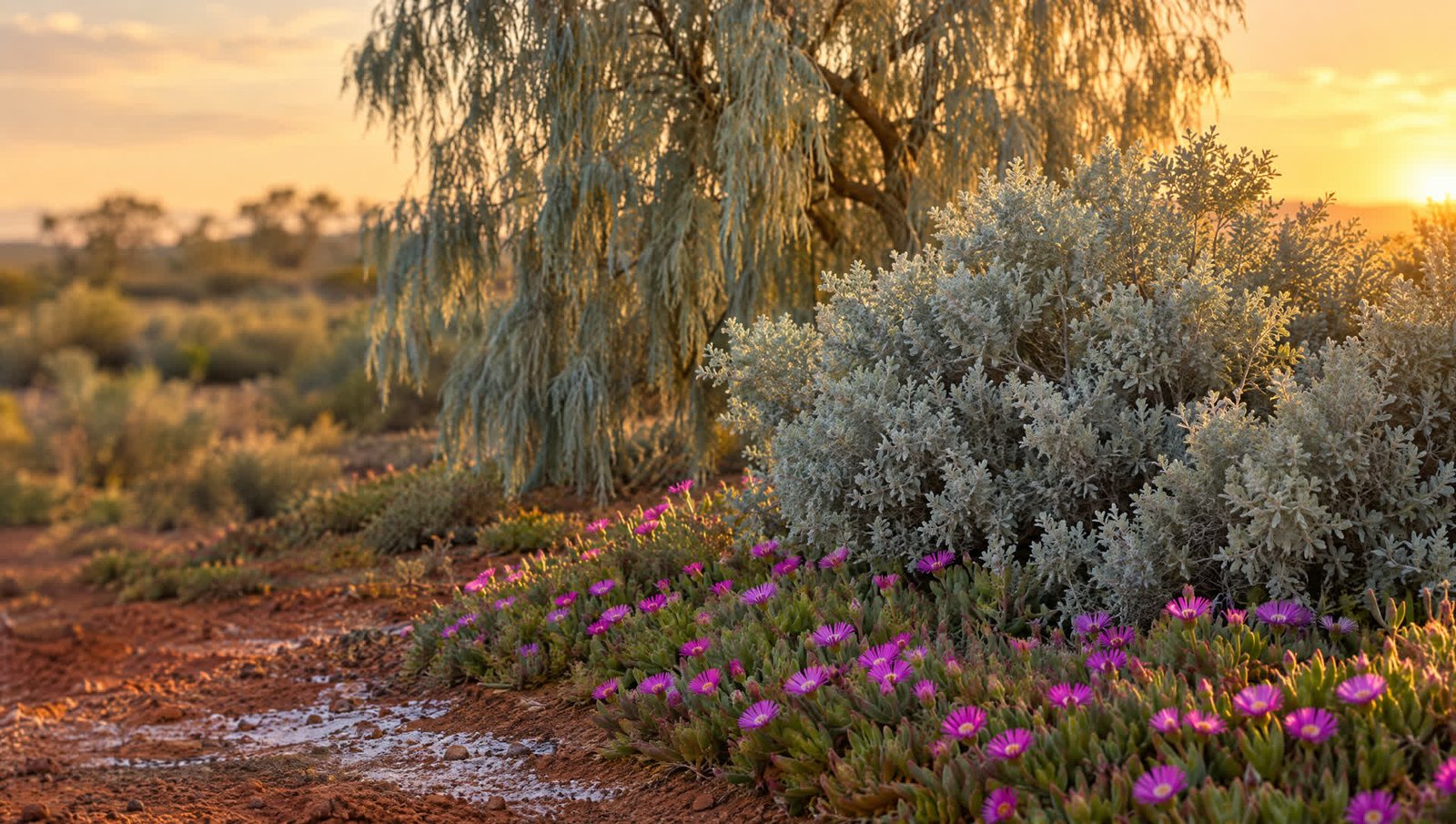
High salt toleranceShrub to 3 m
Old man saltbush
Atriplex nummularia
The benchmark salt tolerant plant for the Mallee. A big, mounding silver-grey shrub for screening, windbreaks and wildlife habitat, and the most widely planted saltbush in Australia.
SaltFrost hardyBird habitat
High salt toleranceGroundcover
Ruby saltbush
Enchylaena tomentosa
A low, spreading groundcover with small red and yellow berries the birds love. One of the most salt tolerant natives of all. Very little care once it's established.
SaltFrost hardyBird attractor
High salt toleranceTree to 5 m
Black tea tree
Melaleuca lanceolata
A true Mallee native and one of the most salt tolerant trees on record. A dense screening tree with masses of white flowers in summer, and great bird habitat.
SaltFrost hardyBird habitat
Moderate to highShrub
Common emu bush
Eremophila glabra
One of the most versatile and good-looking salt tolerant natives, in low, spreading and upright forms with red, orange or yellow flowers. Honeyeaters love it. Plant it on a raised mound in heavier soil.
SaltFrost hardyBird attractor
High salt toleranceTree to 8 m
Coobah, or sally wattle
Acacia salicina
A graceful, weeping tree with pale yellow flowers. Frost tolerant, salt tolerant and quick to grow: one of the best natives for a windbreak or screen on a salty block.
SaltFrost hardyFast growing
ModerateTree to 8 m
Weeping myall
Acacia pendula
The blue-grey weeping tree of the Mallee and Murray floodplains. A beautiful shade tree for low to moderate salinity.
SaltFrost hardy
Low to moderateConifer
White cypress pine
Callitris glaucophylla
A fine-textured native conifer and one of the signature trees of the inland Mallee. Suits sandy, salty soils and makes a long-lived screen or windbreak.
SaltFrost hardy
High salt toleranceGroundcover
Pigface
Carpobrotus rossii
The go-to groundcover for bare, salty patches. Succulent and spreading, with bright pink-purple flowers in spring. It holds the soil and keeps weeds down.
Salt scaldDrought tough
ModerateStrappy grass
Lomandra
Lomandra longifolia and others
Tough, strap-leafed native grasses that hold soil, need almost no care and handle moderate salinity. Good for banks and mass planting.
SaltFrost hardy
High salt toleranceFruit tree
Olive
Olea europaea
Among the most salt tolerant of all fruit trees and made for the Mallee climate. Long-lived, drought hardy once established, and a handsome garden tree. Ask us about eating and oil varieties.
SaltFrost hardyDrought hardy
Moderate to highFruit tree
Fig
Ficus carica
A great performer in the Mallee. Deep roots reach moisture below the salty layer, crops are generous, and the autumn colour is a bonus. Frost tolerant once established.
SaltFrost tolerant
Moderate to highFruit tree
Pomegranate
Punica granatum
From the dry Middle East, a climate a lot like ours. Very drought and salt tolerant, with red summer flowers, autumn colour and striking fruit. Under-planted in Swan Hill.
SaltFrost hardy
High salt toleranceNut tree
Pistachio
Pistacia vera
Exceptionally drought and salt tolerant, and suited to exactly the hot, dry, low-rainfall summers Swan Hill gets. A long-lived tree that does well where others get stressed.
SaltFrost hardyDrought hardy
ModerateFruit tree
Quince
Cydonia oblonga
Hardy and under-rated. Handles dry conditions and moderate salinity easily, with lovely spring blossom and golden autumn fruit. A good alternative to fussier stone fruit.
SaltFrost hardy
ModerateFruit trees
Stone fruit
Prunus: apricot, peach, plum
Swan Hill is stone fruit country. Moderate salt tolerance, so plant on raised beds where it's saltier. Apricots are the toughest. Ask about low-chill varieties.
Salt on moundsFrost hardy
Moderate to highShrub
Coast rosemary
Westringia fruticosa
One of the best all-round shrubs for hard conditions. White to soft mauve flowers, fine grey-green leaves and very good salt tolerance. Makes a lovely informal hedge.
SaltFrost tolerant
ModerateShrub
Lavender
Lavandula
A Swan Hill favourite and a reliable choice on moderately salty ground. French lavender handles our heat better than English types. Trim after flowering to keep it compact.
SaltFrost tolerantBees love it
ModerateHerb
Rosemary
Salvia rosmarinus
A Mediterranean herb made for the Mallee. Drought and moderately salt tolerant, with blue flowers in winter and spring, and handy in the kitchen.
SaltFrost hardy
ModerateShrub
Bottlebrush
Callistemon rugulosus and others
A reliable choice on moderately salty ground, Callistemon rugulosus especially. Red flowers, birds and very little fuss.
SaltBird attractor
Moderate to highSucculents
Succulents and agaves
Agave, aloe, sedum
Their water-storing leaves help them cope with salt, and agaves are especially tough. Good in raised beds, pots and feature spots on a hard block.
SaltLow water
ModerateShrub
Spotted emu bush
Eremophila maculata
Pink, red or white tubular flowers over a long season. Hardy, moderately salt tolerant and loved by birds. Plant it on a mound in heavier soil.
SaltFrost hardyBird attractor