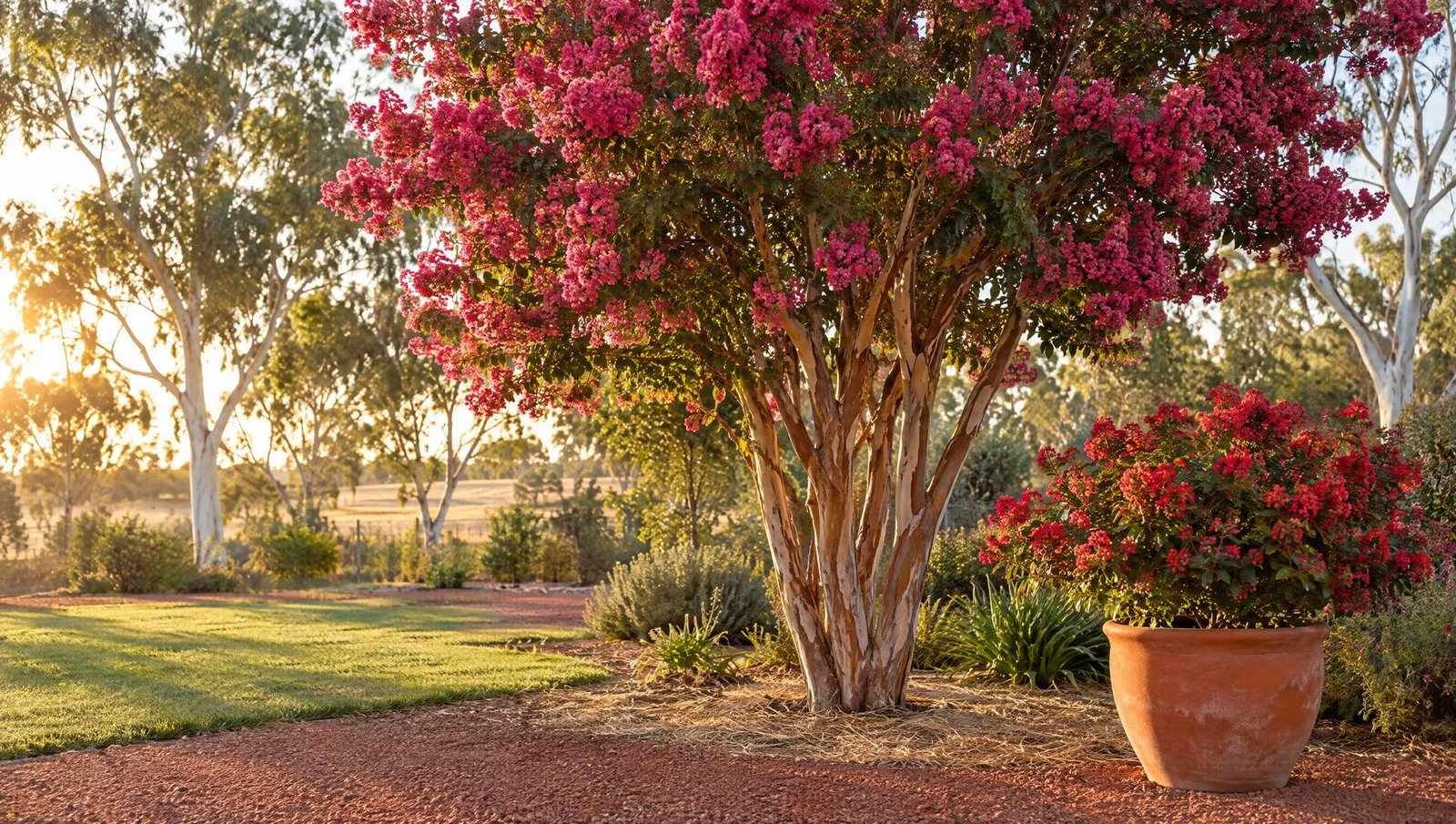
Dwarf1 to 1.5 m
Dwarf crepe myrtles
Lagerstroemia indica dwarf forms
Compact plants in red, pink, mauve and white for pots, small courtyards and the front of a border. The dwarf red is our most reordered crepe myrtle.
Heat tolerantFrost hardyNursery favourite
CompactAbout 1.5 m
'Enduring Summer' Red
Lagerstroemia hybrid
Bright red flowers on a compact, bushy plant, and good resistance to powdery mildew.
Heat tolerantFrost hardy
Compact1.5 to 2 m
'Little Audrey'
Lagerstroemia hybrid
A small shrub-form crepe myrtle for tight spaces and large pots.
Heat tolerantFrost hardy
Dark leaf2 to 3 m
'Diamonds in the Dark' series
Lagerstroemia indica
Deep burgundy, almost black leaves with bright flowers. We stock 'Red Hot', 'Blush', 'Purely Purple', 'Lavender Lace', 'Mystic Magenta' and 'Best Red'.
Heat tolerantFrost hardy
Small tree3 to 4 m
'Zuni'
Lagerstroemia indica x fauriei
Lavender flowers, good autumn colour and mildew resistance. A small shade tree for a courtyard.
Heat tolerantFrost hardy
Tree6 to 8 m
'Natchez'
Lagerstroemia indica x fauriei
White flowers and peeling cinnamon bark that looks good all winter. The pick for a larger shade tree. A bush form is also available.
Heat tolerantFrost hardy
Tree4 to 6 m
Classic crepe myrtle
Lagerstroemia indica
Mauve, white or rubra (deep pink) flowers on the familiar street-tree form.
Heat tolerantFrost hardy
Tropical5 m or more
Queen's crepe myrtle
Lagerstroemia speciosa
Large purple flower panicles. This one is frost tender, so it needs a warm, sheltered spot or a big pot you can move.
Heat tolerantFrost tender