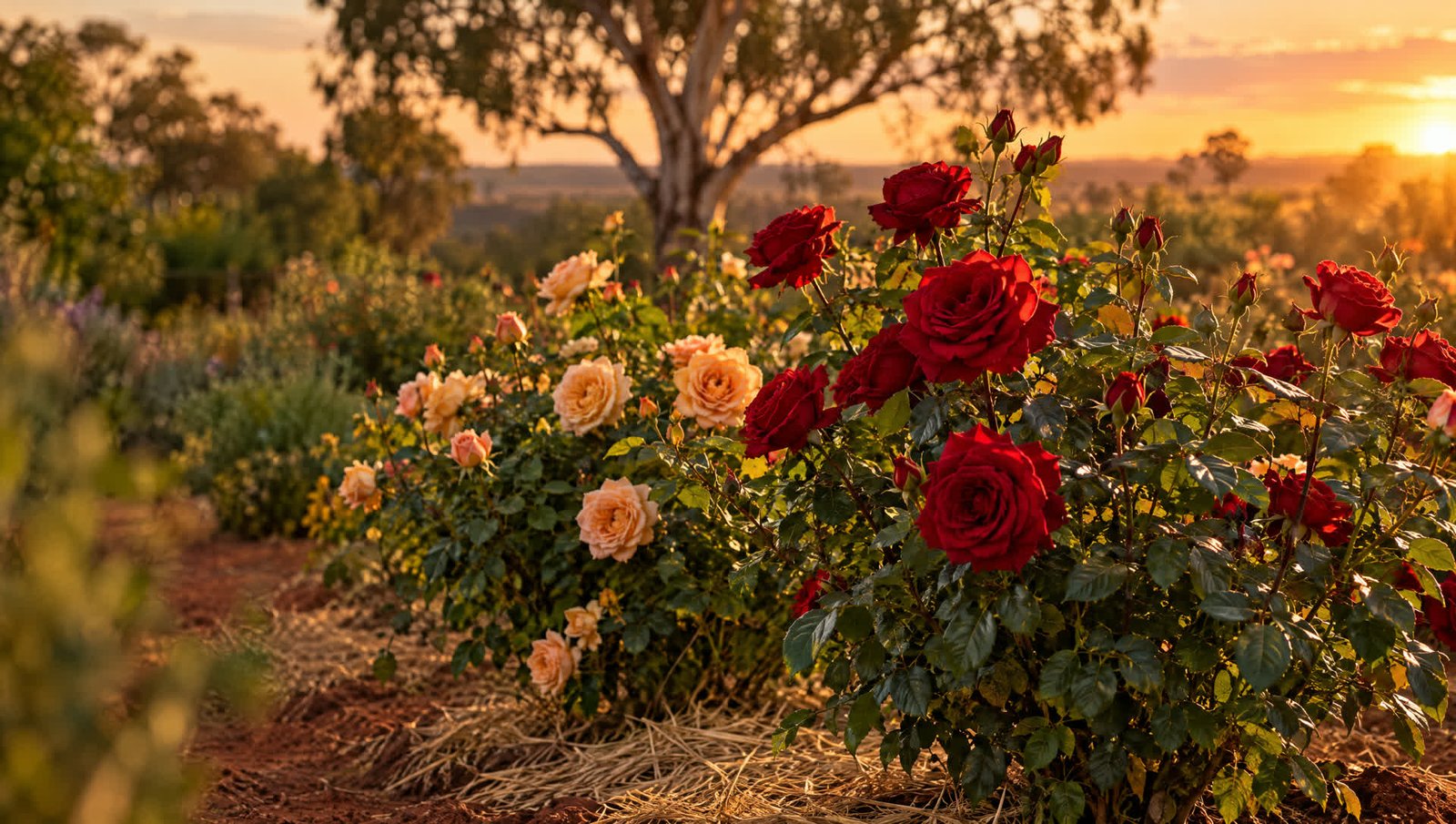
Roses for Swan Hill & the Mallee | Rhimahden Plant Nursery

Swan Hill — Hot Summers, Beautiful Blooms

Roses that love
the Mallee heat.

Roses have an undeserved reputation for being fussy. In Swan Hill's dry climate, the right variety thrives — and actually suffers fewer diseases than in wetter parts of Victoria. Here's how to grow the best roses in town.

☀️
The Mallee advantage Low humidity = less black spot & powdery mildew than coastal gardens
Colours for every garden
White & Cream
Iceberg, Pope John Paul II
Pink
Brilliant Pink Iceberg, Queen Elizabeth
Red & Deep Red
Mr Lincoln, Black Baccara
Yellow & Apricot
Graham Thomas, Apricot Nectar
Bicolour & Blends
Double Delight, Mutabilis
Lavender & Purple
Heirloom, Love Song

Why the Mallee works for roses

The secret? Our dry air
is your roses' best friend.

Most rose problems — black spot, powdery mildew, rust, botrytis — are fungal diseases that thrive in humidity and moisture on leaves. Swan Hill's hot, dry climate is the opposite of what these diseases want. Choose the right varieties, water at the base, and you'll spend far less time spraying than rose growers in Melbourne or along the coast.

The challenge in our climate is different: summer heat and low rainfall. The solution is straightforward — deep watering, heavy mulching, and choosing varieties proven in warm conditions. Get those three things right and roses in Swan Hill can be spectacular.

At Rhimahden we stock varieties we're confident will perform here — not just whatever looks pretty in a catalogue photo. Come in and ask us what's been doing well this season.

What the Mallee climate means for roses

  • Less fungal disease. Low humidity means black spot and mildew are far less of a problem than in coastal gardens. A genuine advantage.
  • Long blooming season. Warm springs trigger early flowering; mild autumns extend it late into May — longer than Melbourne by weeks.
  • Fragrance is stronger. Heat intensifies essential oils in rose petals. A warm Swan Hill evening in a rose garden is something else.
  • ⚠️
    Summer heat is the test. Peak summer can stress roses. Mulch, deep watering, and afternoon protection make all the difference.
  • ⚠️
    Variety selection matters. Thin-petalled varieties ball up and brown in extreme heat. Thick-petalled, heat-tested varieties hold their blooms.

Our Rose Range

Roses for every garden,
proven in the Mallee heat

🌸
★ Swan Hill's best performer
Spring – Autumn
Floribunda Roses
Clusters of blooms · Repeat-flowering · Disease-resistant

If we had to recommend one rose type for Swan Hill gardens, it would be Floribundas — hands down. They produce masses of flowers in clusters, repeat-bloom reliably from spring through to autumn, and the top varieties are genuinely tough in heat and drought. The Iceberg is the gold standard: one of the most heat-tolerant roses in the world, virtually immune to disease in our dry climate, and capable of flowering almost continuously for six months.

Iceberg
Brilliant Pink Iceberg
Burgundy Iceberg
Apricot Nectar
Sexy Rexy
Trumpeter
Showbiz
💧 Water at the base — not overhead
✂️ Deadhead spent blooms to keep them flowering
🌿 Heavy mulch = fewer waterings
☀️ 6+ hours of sun daily
🌹
Classic beauties
Spring & Autumn flush
Hybrid Tea Roses
The classic long-stemmed rose · Perfect for cutting

Hybrid Teas are what most people picture when they think "rose" — one large, high-centred bloom per stem, often highly fragrant, perfect for the vase. In Swan Hill's heat, the key is choosing thick-petalled varieties that hold their form rather than burning off quickly. Mr Lincoln is our benchmark: a deeply fragrant, velvety red that's been proven in hot climates the world over. Double Delight — cream-tipped crimson, extraordinary scent — is another standout. Expect two big flushes (spring and autumn) with some repeat between.

Mr Lincoln
Double Delight
Queen Elizabeth
Mister Lincoln
Pope John Paul II
Black Baccara
St Patrick
🏆 Mr Lincoln — heat-resistant Hall of Famer
✂️ Cut to the 3rd leaf below bloom to rebloom
🛡️ Glossy foliage = better disease resistance
🌿
Spectacular statement
Spring flush + repeat
Climbing Roses
Fences, pergolas & archways

Climbers transform fences, archways and pergolas into something genuinely memorable. In the Mallee heat, the Climbing Iceberg is the safest choice — it brings the same heat-toughness as the bush form but grows to 3–4m and flowers in magnificent abundance. Plant on a west-facing fence for afternoon colour, or train over a pergola for summer shade and seasonal fragrance.

Climbing Iceberg
Pierre de Ronsard
Don Juan
Lorraine Lee
🌱 Don't prune main canes — only laterals
🪢 Tie canes horizontally for more flowers
🌺
Old-world charm
Repeat-flowering
David Austin English Roses
Cup-shaped, heavily fragrant

David Austin's English Roses combine the full, cup-shaped blooms and heady fragrance of heritage roses with modern repeat-flowering capability. Many varieties perform beautifully in warm Australian climates — in fact, English Roses tend to grow larger and more vigorously in heat than in the cooler English conditions they were bred for. Choose disease-resistant varieties and position them where they get morning sun with protection from the worst of the afternoon heat.

Olivia Rose Austin
Graham Thomas
Crown Princess Margareta
L.D. Braithwaite
Bathsheba (Climber)
🌤️ Morning sun — afternoon shade preferred
💧 Need consistent moisture in peak summer
🌷
Underrated gems
Long-season bloomers
Tea & Heritage Roses
Bred for heat · Disease-resistant · Unfussy

Tea Roses — the original "old" roses brought to Europe from China in the early 1800s — are exceptionally well-suited to hot, dry climates. They were likely bred for warm conditions to begin with. Unlike fussier modern varieties, Tea Roses and heritage China Roses shrug off heat, resist pests and disease, and reward with continuous flowering. Mutabilis changes colour as it ages, going from pale yellow to copper to crimson on the same bush — a showstopper.

Mutabilis
Lorraine Lee
Duchesse de Brabant
Lady Hillingdon
Mrs BR Cant
Among the most heat-tolerant of all roses
💪 Very low spray requirements
🌳
Classic Swan Hill favourite
Spring – Autumn
Standard & Tree Roses
Formal elegance · Driveways & pathways

Standard roses — bush roses grafted onto a tall stem to create a "lollipop" shape — are a classic feature of Swan Hill gardens. They bring height and formality to borders, line driveways beautifully, and work wonderfully in pots by the front door. Any floribunda or hybrid tea variety can be grown as a standard, so colour and fragrance choices are broad. They do need staking against the north-westerly winds we get through summer.

Standard Iceberg
Standard Mr Lincoln
Weeping Standard
Standard Queen Elizabeth
🪵 Stake securely against summer winds
🪣 Excellent in large pots near the door
💧

Less disease than you'd expect

Black spot and powdery mildew are humidity-driven. Swan Hill's dry air means these problems are far less severe than in coastal or high-rainfall areas. The right variety, watered at the base, can go seasons without a spray.

🌡️

Fragrance is amplified

Heat intensifies the essential oils that give roses their scent. A warm spring evening in a Swan Hill rose garden — with a Mr Lincoln or Double Delight in full flush — is an experience that wetter, cooler climates simply can't match.

📅

A longer blooming season

Warm springs bring roses into bloom earlier here than in Melbourne. And mild autumns mean the show keeps going well into May. Repeat-flowering varieties can give you six months of colour with the right care.

Mallee Rose Growing Guide

How to grow the best
roses in town

These tips are written specifically for Swan Hill conditions — not generic advice. Follow them and your roses will reward you season after season.

1

Water deep — not often

Shallow, frequent watering produces shallow roots that struggle through summer. Water your roses deeply twice a week in hot weather — soaking the soil to 30cm depth — then let the soil dry partially before watering again. This trains the roots to go deep where the soil stays cooler.

Always water at the base, never overhead. Wet foliage overnight encourages the few fungal diseases we do get. Drip irrigation or a soaker hose is ideal.
2

Mulch like you mean it

A 10cm layer of mulch around the base of your rose is the single most impactful thing you can do in a Mallee summer. It dramatically reduces evaporation, keeps root-zone temperatures stable, and cuts watering needs by half. Lucerne hay is the rose grower's favourite — it adds nitrogen as it breaks down.

Keep mulch 10cm clear of the stem to prevent collar rot. Replenish each spring and autumn as it breaks down.
3

Prune in July — not too early, not too late

In Swan Hill, July is the sweet spot for winter pruning — after the coldest frosts but while the plant is still fully dormant. Cut back by about a third, removing dead and crossing canes, shaping for an open vase centre to promote air circulation. Always cut at 45° just above an outward-facing bud.

After pruning, spray with lime sulphur to kill any overwintering fungal spores and pest eggs. Feed with a slow-release rose fertiliser as new growth appears in August–September.
4

Feed three times a year

Roses in Swan Hill's sandy-loam soils need regular feeding to perform at their best. Feed in September as the first buds open, again in December to support the summer flush, and once more in March for the autumn show. Use a balanced rose fertiliser and water it in well immediately afterwards.

Don't feed newly planted bare-root roses until late November or December — let the roots establish first. Seaweed solution helps with establishment and stress recovery.
5

Position for morning sun, afternoon shelter

Roses need at least 6 hours of sun daily, and an east or north-east facing position is ideal in Swan Hill — morning sun warms them and dries overnight dew quickly, while a fence, wall or taller plant provides some shelter from the harsh afternoon westerlies and peak heat.

Avoid planting under trees — root competition and shade are worse enemies than heat. Space roses 1m apart minimum for good air circulation.
6

Deadhead to keep the flowers coming

Repeat-flowering roses put their energy into producing seeds once a bloom finishes. Remove spent flowers before the hip forms — cut to the first set of 5-leaflet leaves below the bloom — and the plant will redirect that energy into producing the next flush. The difference in a floribunda like Iceberg is remarkable.

In midsummer, a light trim (taking about a third off) will time an autumn flush for March–April — often the best blooms of the year in Swan Hill's gentle autumn warmth.

Your Year in Roses

What to do — and when — in the Swan Hill garden

Autumn
Mar · Apr · May
Enjoy the autumn flush — often the most beautiful blooms of the year
Order bare-root roses from specialist nurseries for winter planting
Feed in March to support the autumn flush, then stop feeding
Prepare new garden beds — dig in compost and aged manure
Winter
Jun · Jul · Aug
Plant bare-root roses — best selection, best value, best establishment
Prune in July — cut back ⅓, open the centre, remove dead wood
Spray with lime sulphur after pruning to reset disease pressure
Apply fresh mulch after pruning. Top up around all established roses
Spring
Sep · Oct · Nov
Feed in September as buds swell — balanced rose fertiliser, watered in well
Watch for aphids on new growth — knock off with a jet of water
Deadhead spent blooms promptly to encourage the next flush
Enjoy the main spring flush — typically at its peak in October
Summer
Dec · Jan · Feb
Water deeply twice a week — more during heatwaves. Never let roots dry out completely
Feed in December to support the summer/early-autumn flush
Summer trim in January — cut back ⅓ to time an autumn flush for March–April
Watch for spider mites in hot dry spells — wet the undersides of leaves in the morning

Bare Root Season:
The best way to start your roses.

May to July is bare-root season — when roses are dormant and available as bare-root plants for a fraction of the cost of potted stock. Bare-root roses establish faster, have a wider variety selection, and are how experienced rose growers always buy. We stock bare-root roses each winter — ask us what's coming in and we'll make sure we have what you're after.

🌹
May — July
Bare Root Season

Come and see us

Ready to grow something beautiful?

Pop in and browse our rose range — or have a chat with Peta-Lyn or John about the best varieties for your garden and your soil. If we haven't got what you're after, we'll do our best to get it.

Tue–Fri 9–5:30  ·  Sat 9–5  ·  Mon & Sun 10–4  ·  Open 7 days